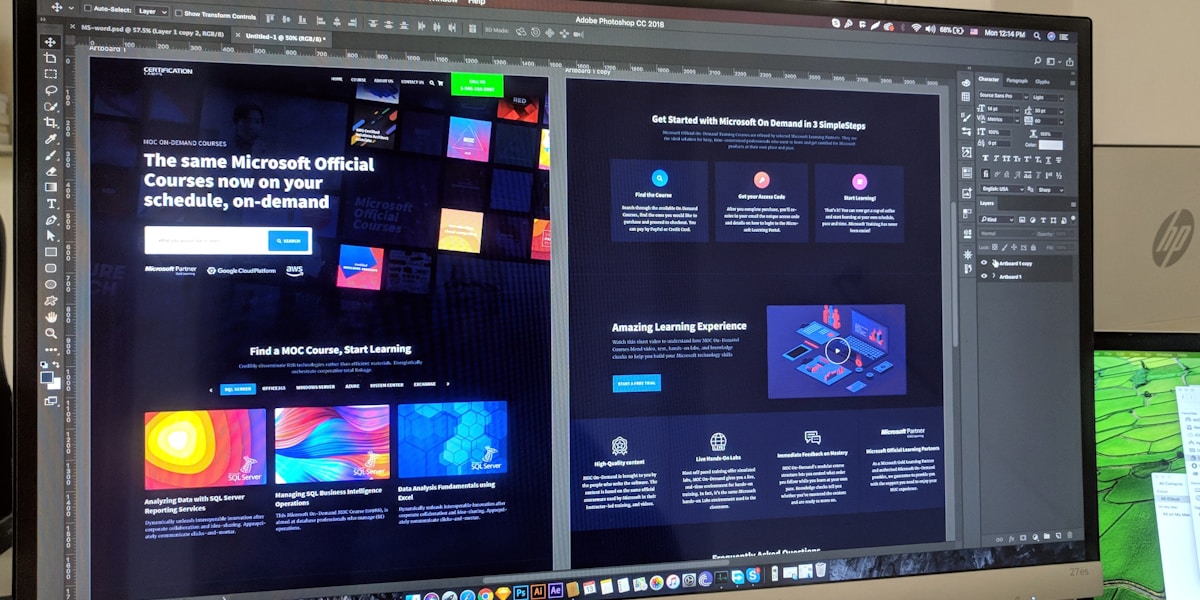
In today's hyper-competitive digital landscape, the d ifference between a thriving business and one that struggles often comes down to a single factor: user experience. User Interface (UI) and User Experience ( UX) design have evolved from nice-to-have elements into essential business str ategies that directly impact your bottom line. At Gosotek, we've witnessed fir sthand how businesses that prioritize intuitive, user-centered design consiste ntly outperform their competitors across every meaningful metric.
First Impressions Are Digital Impressions
You have less than 50 milliseconds to make a positive first impression when a potential customer lands on your we bsite or opens your application. That's faster than the blink of an eye. In th at split second, users form opinions about your credibility, professionalism, and trustworthiness based entirely on visual design elements. Poor UI/UX desig n doesn't just look bad—it actively drives customers away. Research shows that 88% of online consumers are less likely to return to a site after a bad experi ence, and 94% of first impressions are design-related. Investing in profession al UI/UX design isn't about aesthetics; it's about survival in a marketplace w here alternatives are just a click away.
The Direct Link Between UX and Revenue
The financial impact of UX design cannot be overstated. For eve ry dollar invested in UX, companies see an average return of $100—an ROI of 9, 900%. This staggering return comes from multiple sources: reduced bounce rates , higher conversion rates, increased customer lifetime value, and lower custom er acquisition costs. When your digital products are intuitive and enjoyable t o use, customers complete purchases more frequently, spend more per transactio n, and develop loyalty that translates into repeat business. Conversely, poorl y designed interfaces create friction at every step of the customer journey, r esulting in abandoned shopping carts, incomplete sign-ups, and frustrated user s who turn to competitors.
Building Trust Through Consistency
Tr ust is the foundation of any successful business relationship, and UI/UX desig n plays a pivotal role in establishing and maintaining that trust. Consistent visual language, predictable navigation patterns, and transparent interactions signal reliability and professionalism. When users encounter broken links, con fusing layouts, or inconsistent design elements, their confidence in your bran d erodes immediately. Professional UI/UX design creates cohesive experiences a cross all touchpoints—from your website to mobile apps to customer portals—rei nforcing your brand identity and building the trust necessary for long-term cu stomer relationships. In industries where sensitive data is involved, such as finance or healthcare, this trust becomes even more critical.
Reducing Costs Through Strategic Design
Many businesses view UI/UX design as an expense to be minimized, but this perspective ignores the significant cost sav ings that good design provides. Identifying and solving usability issues durin g the design phase is exponentially cheaper than fixing them after development is complete. Studies indicate that fixing a problem in development costs 10 ti mes more than fixing it in design, and 100 times more after product release. F urthermore, well-designed products require less customer support, reduce train ing costs for internal tools, and minimize the need for costly redesigns. By i nvesting in UX research and design early, businesses avoid the expensive cycle of launching, failing, and rebuilding that plagues so many digital projects.
Competitive Advantage in Saturated Markets
In most industries, pr oducts and services have become commoditized. Features that once differentiate d competitors are now standard offerings. In this environment, user experience becomes the ultimate competitive differentiator. Companies like Apple, Airbnb, and Slack have built billion-dollar empires not because their core technologie s were revolutionary, but because they delivered those technologies through ex ceptional user experiences. When functionality is equal, design becomes the de ciding factor. Businesses that recognize this shift and invest accordingly pos ition themselves to capture market share from competitors who still view desig n as secondary to features.
The Mobile-First Imperative
With mob ile devices accounting for over 60% of global web traffic, mobile UX has becom e non-negotiable. However, mobile design isn't simply about making desktop int erfaces smaller—it's about fundamentally rethinking how users interact with yo ur business on touch screens with limited real estate and varying network cond itions. Responsive, mobile-first design ensures that your digital presence del ivers value regardless of how customers access it. Google's mobile-first index ing means that your mobile UX directly impacts your search engine rankings, ma king it a critical component of your SEO strategy. Businesses that fail to pri oritize mobile UX are effectively invisible to the majority of their potential customers.
Conclusion: Design as Strategy
UI/UX design has trans cended its origins as a purely creative discipline to become a core business s trategy. In an era where digital interactions increasingly define customer rel ationships, the quality of those interactions determines business outcomes. Co mpanies that treat design as an afterthought will find themselves perpetually playing catch-up, while those that embed user-centered thinking into their org anizational DNA will continue to lead their markets. At Gosotek, we partner wi th businesses to transform their digital experiences from liabilities into com petitive advantages. The question is no longer whether you can afford to inves t in UI/UX design—it's whether you can afford not to.